
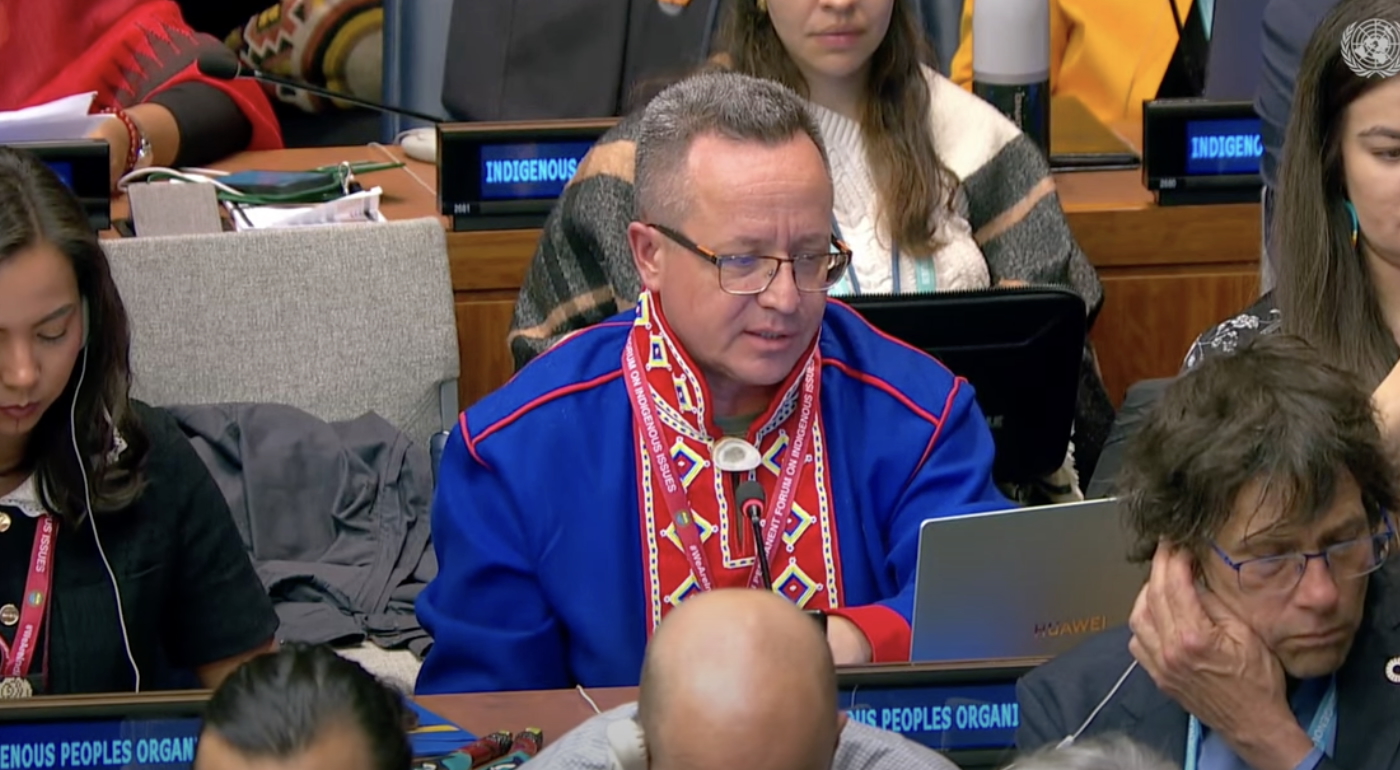

Thank you, Mr. Chair,
I represent the Kola Sámi Association of Russia. The Sámi people live in four Northern countries: Norway, Finland, Sweden, and Russia. Therefore, we attach particular importance to international cooperation. Article 36 of the Declaration (the United Nations Declaration on the Rights of Indigenous Peoples – editor’s note, iR) affirms the right of cross-border Indigenous peoples to maintain and develop their contacts. It also requires States to facilitate the exercise of this right. Article 39 establishes our right to financial and technical assistance from States and through international cooperation. Articles 41 and 42 contain provisions regarding the role of the United Nations system.
What do we see in practice? Unfortunately, states often neglect their obligations to support international cooperation among Indigenous peoples. Instead of providing funding for cooperation, they may use money as a tool for manipulation, undermining long-standing relationships. Instead of promoting sustainable development, they weaken its foundation by imposing unilateral coercive measures (this refers to Western sanctions against Russia. In recent years, RAIPON has actively advocated on behalf of the Russian government for the lifting of these sanctions – editor’s note, iR).
Let me give you a striking example.
In 2022 (the year Russia launched its full-scale invasion of Ukraine – editor’s note, iR), we received a letter from the Saami Council — the international organization of the Sámi people — informing us that cooperation with Sámi organizations in Russia would be suspended. The reason given was that donors — the Nordic countries (meaning member states of the Nordic Council of Ministers – editor’s note, iR) and other partners — had demanded that Western Sámi (i.e. Sámi from Norway, Sweden, and Finland – editor’s note, iR) stop communication with Russian Sámi, under the threat of losing funding. (In reality, it was the Nordic Council of Ministers that decided to suspend its operations in Russia after the full-scale invasion – editor’s note, iR.)
Yet the main goal of the Saami Council is to strengthen the sense of unity as one people, and to defend Sámi rights both within states and at the international level. By threatening the Saami Council with the withdrawal of funding, the Nordic countries are contributing to division within our cross-border Indigenous people, and violating Articles 36 and 39 of the Declaration.
Through their actions, they have in fact dismantled international Indigenous cooperation in the Arctic Council and the Barents Euro-Arctic Working Group of Indigenous Peoples. At the same time, in order to maintain their image within the UN Permanent Forum, the Nordic countries regularly express their support for expanding Indigenous participation in the work of the United Nations.
We call on the Nordic countries to stop putting pressure on international Indigenous contacts. We also call on all states to refrain from hindering Indigenous international cooperation through unilateral visa, logistical, or financial restrictions.
In this context, we express our support for the joint statement issued by the three UN mechanisms on the eve of the 24th session of the Permanent Forum, emphasizing the importance of ensuring Indigenous peoples’ participation in UN processes.
Each year, participation becomes more difficult. We call on the Permanent Forum to consider relocating its annual sessions to UN offices in locations with more favorable conditions, such as Bangkok or Nairobi. We also request that the Forum study the impact of unilateral coercive measures and restrictions (again referring to Western sanctions against Russia – editor’s note, iR) on the realization of Indigenous peoples’ rights.
Thank you.