
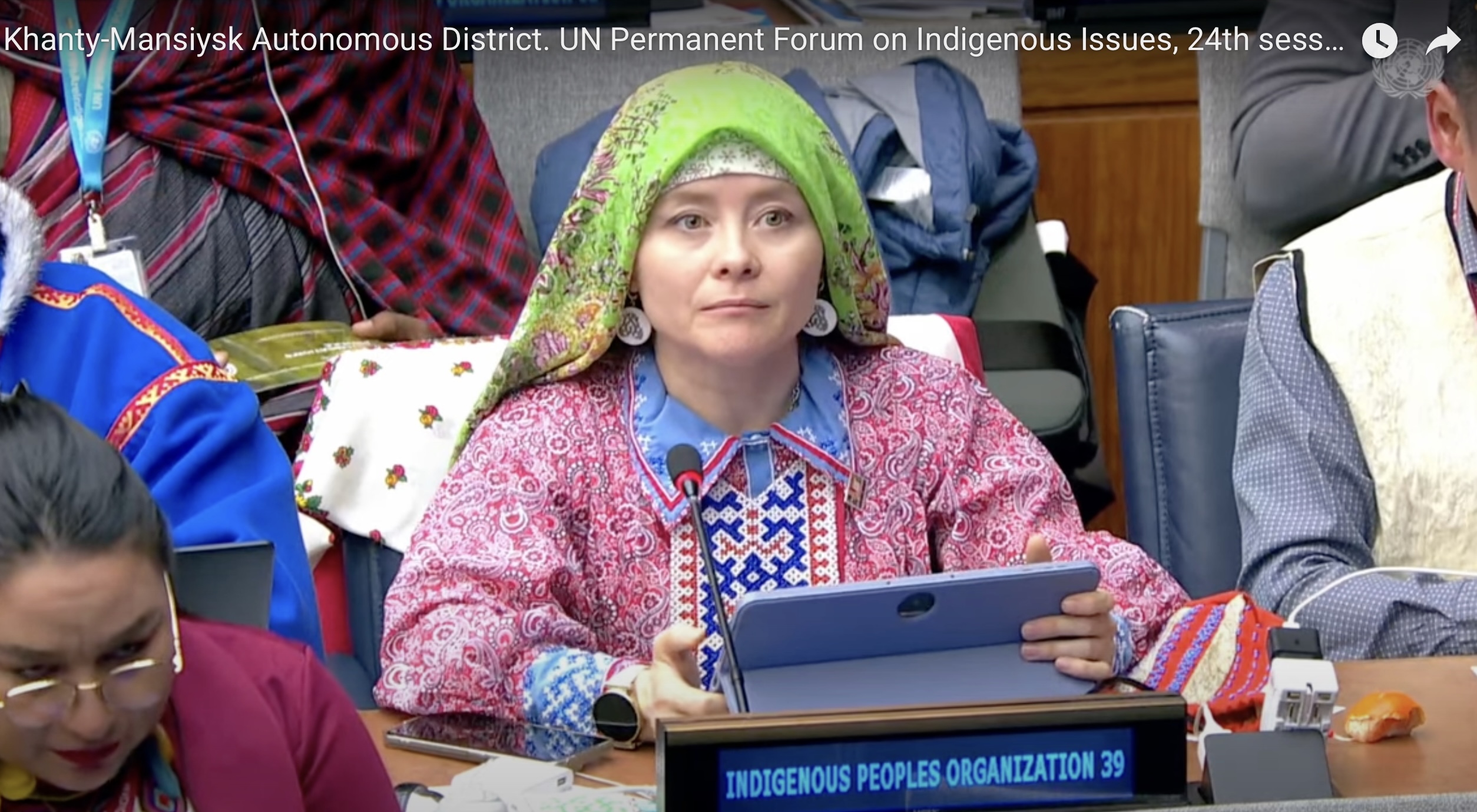

Thank you, Mr. Chair.
I would like to begin by expressing my deep concern regarding the conduct of Permanent Forum member Ms. Valentina Sovkina, who, in my view, lacks impartiality and has been actively engaged in shaping negative narratives against my country. While we acknowledge the challenges we face, we also take pride in the significant achievements that many countries can only aspire to.
I represent the Khanty-Mansi Autonomous Okrug, also known as Yugra — a region of the Russian Federation that serves as a territorial autonomy for three Indigenous Peoples of the North. According to the will of the god Torum, our land yields half of the country’s oil production. At the same time, approximately 135,000 square kilometers — or 25% of the territory — are officially designated for use by Indigenous families. My own family holds such a territory where our clan has lived for centuries.
Regrettably, like many of my neighbors, our ancestral land is subject to extractive industrial activities. We do not oppose economic development per se, but it must occur with full respect for our rights.
Over the past 30 years, Yugra has developed a comprehensive legal framework for the protection of Indigenous Peoples’ rights in the context of industrial development. Central to this framework are state-monitored requirements for extractive companies to obtain written agreements with the Indigenous landholders prior to the siting of any industrial facility. Upon receiving such agreement, companies are also obliged to negotiate and provide compensation.
Our primary priority in these negotiations is to prohibit industrial projects where possible. While the law does provide for a de facto veto right, in practice it is difficult to enforce. Where prevention is not feasible, our goal is to minimize environmental and cultural harm, and only then to seek compensation in accordance with legal provisions.
Each year, approximately 1,000 such agreements are signed between Indigenous families and companies in our region. In addition, companies enter into agreements with the regional and local governments to support infrastructure development in Indigenous areas.
However, although government regulations are mandatory, they often fail to account for the full complexity of the situation. Industrial actors frequently seek to limit both their obligations and their financial responsibilities toward Indigenous communities.
In my own case, a company refused to enter into an agreement altogether, claiming that, as a well-known folk singer and public figure, my connection to the land was somehow less legitimate than that of a reindeer herder.
The State is a vast mechanism that often reacts slowly and does not always recognize emerging problems. In such conditions, it is incumbent upon companies to act in good faith and uphold not only legal obligations but also voluntary corporate commitments to the rights of Indigenous Peoples.
I urge the Permanent Forum and other relevant UN mechanisms to take this matter under consideration.