
Mikkel Berg-Nordlie, Tone Maia Liodden, and Anne Balke Staver, senior researchers, NIBR-OsloMet, Oslo
This article is an opinion piece written by external contributors and reflects their views.
Is the principle of equal treatment at risk in the debate about Sami asylum seekers?
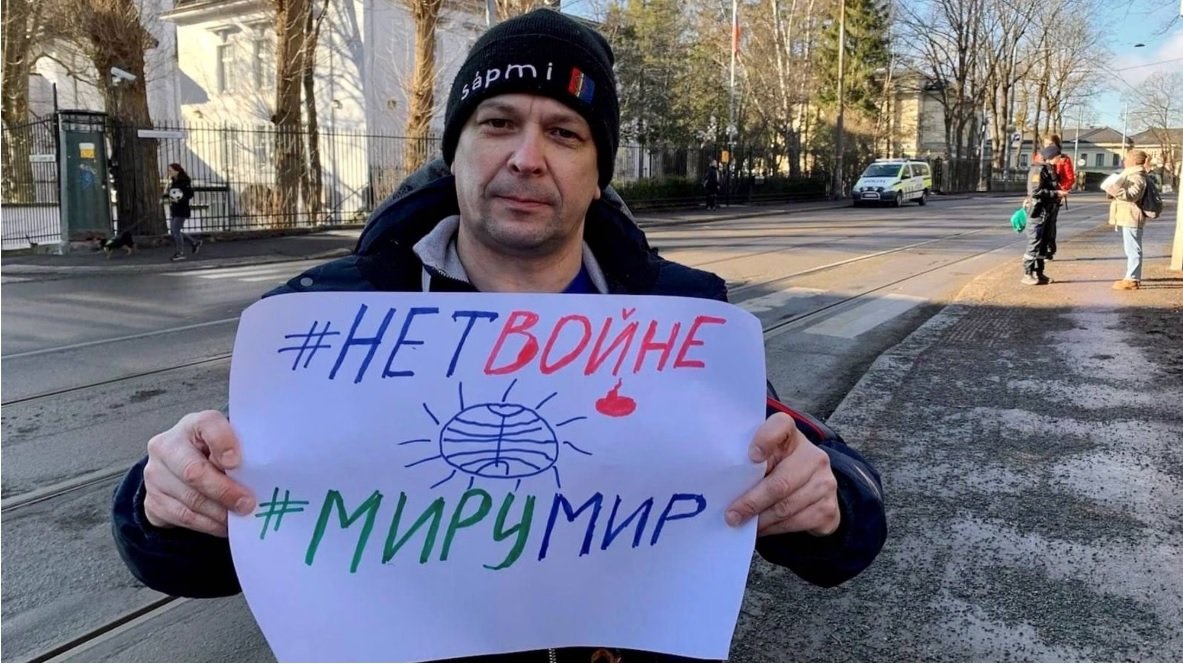
When Russia launched its full-scale invasion of Ukraine in 2022, Sami democracy and environmental activist Andrei Danilov took a stand against the war and became Norway’s first Sami asylum seeker. The Directorate of Immigration (UDI) believed Danilov should be sent to Switzerland under the Dublin Regulation: he had a visa to Switzerland and, according to UDI, no “special connection” to Norway. The Sami Parliament and others protested: the Sami have a special connection to the entire Sápmi region, which is not divided by national borders. The Immigration Appeals Board (UNE) concluded that Danilov should “have his application processed in one of the states that are part of the traditional Sami settlement area.”
The Sami Parliamentary Council (SPR) now proposes that Sami individuals should have the right to have their asylum applications processed in any state that includes part of Sápmi. SPR is the cooperative body of the Nordic Sami parliaments and holds high symbolic status, but it is unusual for them to set an agenda in public discourse. This time, they have sparked debate.
Opposition presidential candidates ahead of the Norwegian Sami parliamentary election, Vibeke Larsen (NKF) and Svein Atle Somby (AP), are critical. They believe Sami should not be treated differently from other refugees and have later received support from the Progress Party’s Erlend Wiborg.
There is a need for clarification in the debate. Firstly, Norwegian authorities can already, under current regulations, consider Sami ethnicity when assessing asylum applications: ethnicity is one of the grounds in the Refugee Convention, upon which Norwegian law is based. A person may be persecuted because they belong to a specific ethnic group or due to the interaction between ethnicity and political opinions. This applies not only to the Sami; for example, it is often relevant for Kurdish asylum seekers from Iran.
Secondly, SPR does not want Sami asylum applications to be assessed differently, but that the applicant’s Sami ethnicity should influence which country processes the asylum application. This is already possible under the Dublin Regulation: states can choose to process cases even if the applicant arrived in another country first or has a visa from another country. Such exceptions can be made, for example, for individuals who have close family members in the country. Indigenous affiliation is a new element that is important to consider in principle – as UNE has indicated should be done in the Danilov case.
In Australian law, we even see that foreign nationals who are part of the country’s indigenous peoples cannot be expelled from the country: indigenous affiliation is considered to give them such a strong connection to the land that they cannot be regarded as “foreigners” in a legal sense. If Nordic states were to follow the same principle, the question arises whether Sami from abroad can be deported at all, for example, if they are denied asylum. However, SPR has neither proposed nor argued for such a measure.
SPR has instead proposed that while Sami asylum seekers are in the country, they should have the right to maintain their culture by living in Sami communities and having access to Sami cultural and educational offerings. In Norway, we have a system of managed refugee settlement: to access rights, they cannot settle wherever they want during the initial period after being granted asylum but are placed in municipalities that agree to receive them. However, authorities have shown flexibility towards a specific group previously: Ukrainians have, to a greater extent than other refugees, been allowed to settle in the municipality they first arrived in or in places where they have networks. There is thus room within current regulations to be flexible – although this depends on the goodwill of the municipalities.
The most challenging question is perhaps whom UDI should consider as Sami? In the Nordic countries, we have Sami parliaments with their electoral rolls, which have clear (albeit somewhat contested) rules. In Russia, there are neither Sami parliaments nor electoral rolls.
This is also a security issue. There is a real risk that Russian authorities could send in false “Sami” to carry out missions. How can one guard against this? What kind of documentation or other forms of substantiation should be considered sufficient proof that an asylum seeker is Sami? This is complicated but not entirely new: caseworkers’ assessment of credibility is often crucial for the outcome of asylum applications.
In any case, it will never be sufficient to obtain asylum merely by proving Sami affiliation: the asylum seeker must also demonstrate that they risk persecution in their home country.
Thus, SPR’s proposal does not entail a separate asylum system for the Sami: existing regulations can be used in such a way that facilitates Sami who must flee from their own authorities or foreign occupiers to have their asylum applications processed in other parts of Sápmi and to live in Sami communities. Today, it concerns Russian Sami, but it is worth remembering that in our recent past, Sami from Norway and Finland have also had to flee from acts of war, and we can never be entirely certain about the future: also for Nordic Sami, it may one day be useful to have the right to live among people with somewhat the same language and culture.