
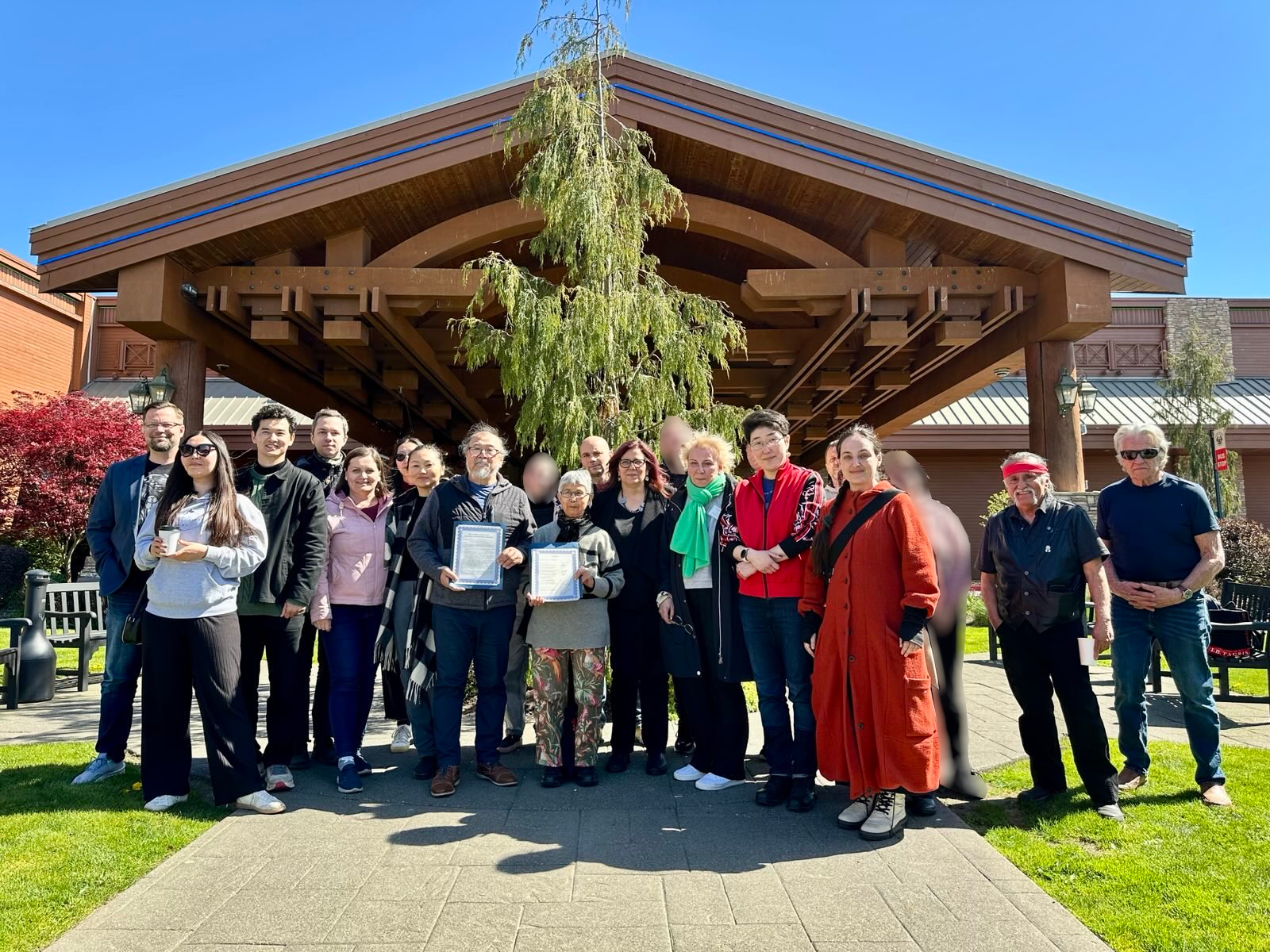
From April 14 to 17, 2025, a historic international conference was held on Orcas Island, Washington State, USA, on the traditional lands of the Lummi Nation. The event focused on the situation of Indigenous Peoples of the Russian Arctic and Siberia in both present-day and post-Putin Russia. The conference was organized by the International Indigenous Fund for Development and Solidarity “Batani”, the International Committee of Indigenous Peoples of Russia, the Indigenous Russia information center (iRussia), and Russian America for Democracy in Russia (RADR).
The conference brought together representatives of Indigenous Small-Numbered Peoples of the North, Siberia, and the Russian Far East, Russian civil society, scholars, policymakers, human rights defenders, activists, journalists, and international partners. The gathering served as an open dialogue on Indigenous rights, Russia’s imperial policies, decolonization, and the democratic future of Russia. A foundational document was adopted at the conference — the “Orcas Island Declaration: A Statement on Reconciliation and Respect.”
April 15: Day One
The first day of the conference featured four substantive sessions:
- The Situation of Indigenous Small-Numbered Peoples of the North, Siberia, and the Far East – Representatives of the Itelmen, Saami, Dolgan, Udege, Shor, and other Indigenous peoples spoke about the current human rights situation in their respective regions.
- Contemporary Challenges – Participants discussed the consequences of state repression, human rights violations, environmental exploitation of traditional lands, and the role of international mechanisms in Indigenous rights protection.
- Russia’s Future: Decolonization and Self-Governance – Experts debated various models for Russia’s future political structure, with a focus on recognizing and protecting Indigenous rights.
- Cooperation with Pro-Democracy Movements – Participants explored the current state of collaboration between Indigenous organizations of the North, Siberia, and the Far East and Russia’s pro-democracy movement, and proposed concrete steps to strengthen dialogue and coordination.
April 16: Day Two
The second day was dedicated to the collective development of the conference’s foundational outcome document. Participants engaged in discussions and consultations, which culminated in the adoption of the “Orcas Island Declaration: A Statement on Reconciliation and Respect“.
Adoption of the Orcas Island Declaration

The principal outcome of the conference was the adoption of the “Orcas Island Declaration: A Statement on Reconciliation and Respect” — a historic and foundational document which:
- Condemns colonial policies, assimilation, and repression targeting Indigenous peoples in Russia;
- Emphasizes the need to restore historical justice;
- Affirms a commitment to working jointly with democratic forces toward a future based on equality and human rights;
- Announces the establishment of a permanent platform for dialogue;
- Sets forth specific objectives: monitoring of rights violations and provision of legal support, development of legislative initiatives to protect the rights of Indigenous Small-Numbered Peoples and their access to land and resources, and advancement of research and educational programs.
The Declaration is inspired by the experiences of reconciliation in Canada, the United States, Australia, and Norway, and calls on Russia to embark on a similar path — one that includes recognition of its colonial policies, the restoration of respect for Indigenous Small-Numbered Peoples, and meaningful institutional change. Its significance extends far beyond the conference itself: it serves as a moral and political reference point for the broader Russian community working to uphold the rights of Indigenous Small-Numbered Peoples.

In the afternoon, representatives of the Lummi Nation hosted a special community event for conference participants and residents of Orcas Island. The program featured speeches by members of the Native American organization Se’Si’Le, as well as Pavel Sulyandziga, Tian Zaochnaya, and Vladislav Inozemtsev. This gathering served as a symbol of international solidarity and a powerful reminder of the shared histories of colonization and the ongoing efforts to restore the rights of Indigenous peoples.
April 17: Day Three
On the final day of the conference, participants were invited to visit the Lummi Nation reservation, where they met with members of the Tribal Council. This visit was not only an expression of respect and gratitude, but also the beginning of a lasting partnership between Indigenous peoples of Russia and the United States.
The conference marked a significant step toward building a new Russia — democratic, inclusive, and grounded in respect for the right of every people to self-determination and dignity.
Joint Press Release by the Editorial Team of Indigenous Russia (iR) and Russian America for Democracy in Russia (RADR)


